jeudi 11 avril 2013

SENSORITES

Planet of Origin: Sense Sphere, a planet from a system of two suns - which never had nights, situated in the Horsehead Nebula, some 1500 light years from Earth, which is rich in molybdenum and is the home of the sensorites. Another planet in the same system, the OOd sphere, houses a genetically related species, the Ood. How those two species, most probably of common origin managed to end up on different planets remains unknown.

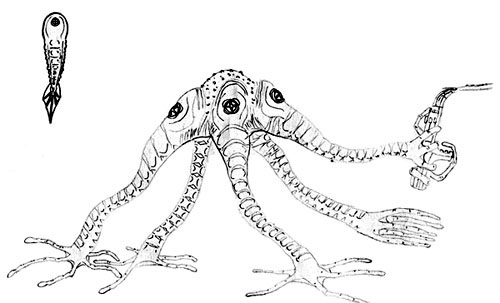
Sensorites were a telepathic humanoid race that developed an industrial civilisation. Their head is  bulbous, their eyes large and black with no eyelids. They have white whiskers around their mouths. They are very sensitive to loud noise and fear darkness. They appeared almost identical, even to themselves and wear accessories with their otherwise identical grey bodysuits to denote their social status.
Early in their history, the Sensorites worshipped giant spiders called  Zilgans that lived in dark caves on their world, since they lived in the darkness that they feared so much. They would feed them criminals and would be left on their own. In the 28th century, a human exploration mission made contact with the Sensorites and attempted to exploit their world's mineral wealth. After an uneasy start, they managed to make an agrement that exploitation would be minimal and would ne bother the Sensorites.
Source: Doctor Who, TV: The Sensorites 

dimanche 7 avril 2013

RILLS

Planet of origin: An unknown plant in Galaxy 4.
Rills are a sentient ammonia-breathing species which developed  an advanced pacific spacefaring civilisation with intergalactic capacities.
They are large, scaly sexuate creatures with massive skulls, wide mouths and large eyes. They rely on their telepahtic abilities to communicate, being unable to do so verbally. Tey have very long liespan and a slower perception of time than most species. It remains unclear if this is their natural  state of being or if this came about after genetical manipulations they went thru in order to increase their original lifespan. It takes them a thousand years ot mature and their normal reaction time is fifty times slower than a human.  In order to deal with other species, they are able to increase their reaction time for short periods but find this practice unstelling. Solitary beings, they prefer to spend most of their time thinking, leaving physcial tasks and interaction with others to robots called Chumblies. 
Source: Doctor Who universe, Galaxy 4

CHULA

The Chula are a humanoid sentient species which developed and adcanced spacefaring civilisation as of the twentieth century or before. They are known to have been participating in wars, having developed powerful  medical nanogenes which could restore even dying or dead soldiers to action. Those nanogenes were usually carried in automated medical ships droppes on the battlefield from where they could start repairing the injured. Such as medical ship has been known to crash on Earth in London during WWII. The effects of the nangogenes were contained and the ship destroyed.
Source: Doctor Who universe (The Empty Child/The Doctor Dances) 
Notes: Although no Chula are seen, the pilot seat from one of their ships seen in the aforementionned episodes is clearly made for a humanoid.

TOGONS / VENICOBANS

Planet of origin: an earth-like planet orbiting Venicoba Centauri in the Milky Way galaxy.
Togons are a sentient bipedal reptilian species which developed an agressive industrial civilisation on one continent of a planet orbiting Venicoba Centauri. They are constantly at war with the peaceful humanoid community which established themselves on the planet's other major continent, the Sharbakan. The only thing preventing the humanoids, somehow related to the Aktarkans, from being decimated by the Togons is the presence of a disruptor field around their continent.
The togons are covered in yellow scales and sport as red crest on theit head. They like to ride Zrills, pink ostrichlike reptiles with a strong sense of smell.
Source: The Scrameustache series, by Gos and Wal, "Le Sosie"

jeudi 28 mars 2013

AKTARKANS


Planet of Origin: Aktarka, an earth-type planet with two major continents and two very large moons that orbits around a G type star in the Milky Way galaxy. Although they will most likely refer to themselves as coming from the continent of the two moons (Continent des deux lunes) than as Aktarkans.
Aktarkans are humanoids that are undiscernable from normal Earth humans which have developped a pacifist non-expansionnist space faring technological civilisation more than 2000 years ago. They are known to have visited the solar system and have established some bases at least on Earth and the Moon. They are governed by a council and practice a strict birth control policy according to which a family cant have more than 2 children, which even seems to be an exception. Their population is very low and they are widely spread on the continent of Aktarka which always faces its two moons. They are known to send emissaries to less advance humanoid civilisations (which they call Inferior planets) and discretely tutor them.
If Aktarkans and humans have common origin remains unknown but their similarity lets believe it could be the case.
Aktarkans have mastered gravity manipulation, FTL travel, interstellar range communication and teleportation and limited time-travel. They appear to use automation and robotics as little as possible, same thing for genetic manipulations, although they seem to posses advanced knowledge in the field .
Source: The Scrameustache series, by Gos and Walt

Mobile Aktarkan interstellar station. 
Such vehicles are equipped with 3 exploration shuttles, FTL drives and interstellar teleport stations.

mardi 26 mars 2013

ZULTANN / ZULTANNIANS/ ZULTANNIENS / BYRAMS

Planet of Origin: Byram, an Earht-type planet in theMilky Way Galaxy with two major continents, one called Zultanniam populated by the native Zultanns, the other, called Atlantis 2, populated by survivors of Earth's Atlantis some 12 000 years ago..
Zultanns are a humanoid species which has developed a monarchical peaceful space-faring civilisation. They are blad and yellow skinned, with large bleu eyes. Some are known to possess powerful psychic abilities. They've shared their planet with a human population which migrated on their world some 12 000 years ago following the fall of Atltantis. Contact between the two races remained scarce for a long time as each species occupies a distinct continent, and even with the advance of their respective technologies, they remained dubious about one another until a altantean princess got engaged to a zultann prince at the beginning of the third millenium. They are known to have come to Earth on rare occasions and are genetically compatible with humans. Half-breed offsprings are known ot retain most Zultann traits but with human hair and skin color.
Source: The Scrameustache series, by Gos and Walt , "Les naufragés du Chastang", "L'épreuve du sablier".

mardi 5 mars 2013

OURANOS / URANUS / ADVENTS / CREATORS

It remains unknown if the entities know as the Creators were one species or an interestellar association of different species but were most probably humanoid as they created the Guyver Units which they used during their visit on Earth. They are believed to have manipulated life on Earth over millions of years to create a biological weapon  which resulted in the creation of humans. With whom they were at war remains a mystery. Their technology is believed to have been advenced enough to enable them to  move planets across galactic distances.They seem to have disappeared but left their creations behind.
Source : Guyver universe

dimanche 24 février 2013

FROGS


The beings named Frogs by the humans of the 3rd millenium. are a sentient humanoid species which has developed an advanced space faring civilisation whose behaviour seems antagonistic to the humanity of the time. They appear as blurry sparkling humanoid shapes. It remains unknown if this is their true appearance or if this is due something shielding them. As such, they appear immune to beam weapons but exposition of oxygen is toxic to them.
Source: Tv series Raumpatrouille – Die phantastischen Abenteuer des Raumschiffes Orion (literal translation: Space Patrol – The Fantastic Adventures of the Spaceship Orion), also known as Raumpatrouille Orion, and Space Patrol Orion in English.

dimanche 17 février 2013

DENOBULANS


Planet of Origin: Denobula, the only planet orbiting  the star Denobula Triaxa AKA Iota Bootis, some 95 light years from Earth, in the Milky Way galaxy.
Denobulans are near-human looking humanoids with prominent facial ridges running down either side of the forehead to the cheeks, an enlarged brow ridge under a high receded hairline, a vertical crevice in the center of the forehead, and a ridged chin. They also have ridges on their back, along the spine. Their toenails are  dark brown and yellow striped, and they grow so rapidly that they need to be groomed once a week. Denobulans also had very long tongues, and they used tongue scrapers. Denobulan males had a line of hair down the middle of their chest, up to their throat. . They  have the ability to enlarge their faces when they feel threatened.  and they can change their eye color depending on their moods. . They  normally require  very little sleep, but do hibernate for five to six days each year. However, at a minimum, two days are sufficient. If a Denobulan is awakened prematurely, the results can be somewhat unpredictable; hibernating Denobulans, if woken, appeared extremely disoriented and confused, with oddly-pitched voices, and had difficulty maintaining normal motor skills and cognitive functions. Denobulans have  highly-efficient natural climbing abilities similar to those of Earth lizards, being capable of scaling vertical rock faces at a rapid speed with no equipment whatsoever, appearing to scuttle up the rock face without needing to find handholds and possess particularly powerful immune systems. Their exact life expectancy  is not known, but indications suggest that lifespans are extremely long.
On their homeworld,  the twelve billion Denobulan inhabitants all share one continent, resulting in  Denobulan culture having come to embrace close, communal lifestyles.  Denobulan medical ethics considers  a patient's will to be absolutely binding, including his denial to be cured or live.  Denobulans are typically polyamorous, where a man typically has three wives, who each has three husbands lcreating extremely large extended families. In addition, marriages are not exclusive, and married Denobulans can be intimate with anyone they chose. The females emit powerful pheromones during their mating season. Male Denobulans often became combative during this time, and mating can require medical supervision. Denobulans typically preferr to be among large groups and find solitude uncomfortable. However, Denobulans, at least males, are uncomfortable being touched by persons they are not intimate with and are more sexually inhibited than the females of their species.  Although Denobulans don't keep pets, they tend to address or greet animals they meet by imitating their sounds, even insects. 
Since the 20th century, the Denobulans practiced genetic engineering, with generally positive results and, by the 22nd century, the Denobulans had experimented with nanotechnology.  
The Denobulans believed they were the only intelligent species in the galaxy until the B'Saari made first contact.  Denobulans fought several wars against the Antaran species. The last one was during the late 19th century. Denobulan battle tactics killed twenty million Antarans. Both species demonized each other). As of the 22nd century, there were still some Denobulans that hated Antarans, although most had outgrown the hatred. . The Denobulans first met the Human race sometime prior to the 2130s. By the 2130s, Denobulans and Humans had built the joint research station Cold Station 12. When the Vulcans formed the Interspecies Medical Exchange, Denobulans were involved and contributed medical personnel. . In 2155, a Denobulan ambassador was sent to Earth to join in talks of forming a Coalition of Planets.

samedi 16 février 2013

XI'AN


The Xi'An are a long lived (several hundred years) reptilian-looking humanoid species which developed an expansive interestellar civilisation which occupies at least fourteen systems in the Milky Way galaxy. While not inherently aggressive or expansionist in their nature, the Xi'An history is rife with civil war and power struggles with the result that all X'ians, military or civilian, are apt fighters. However, they prefer subtlety and manipulation to overt conflict.
Their political system is based on hereditary monarchy.  The emperor has a High Council of Advisers, each representing a facet of the government. Each colony emulate this structure with every planetary council member reporting to their respective counterparts on the Emperor's Council.
The Xi'An Empire had first contact with humans in 2530 and this encounter immediately escalated into a 259 year cold war (2530-2789). 
Source: Star Citizen Upcoming game by Chris Roberts and Roberts Space Industries.
Note: This species has been announced as being part of the upcoming Star Citizen game universe. More informations will become available when the game comes out.

mercredi 13 février 2013

WAVICLE SPORE / PLASMACYTES / BLOODWORM / SPARKLE DANCER


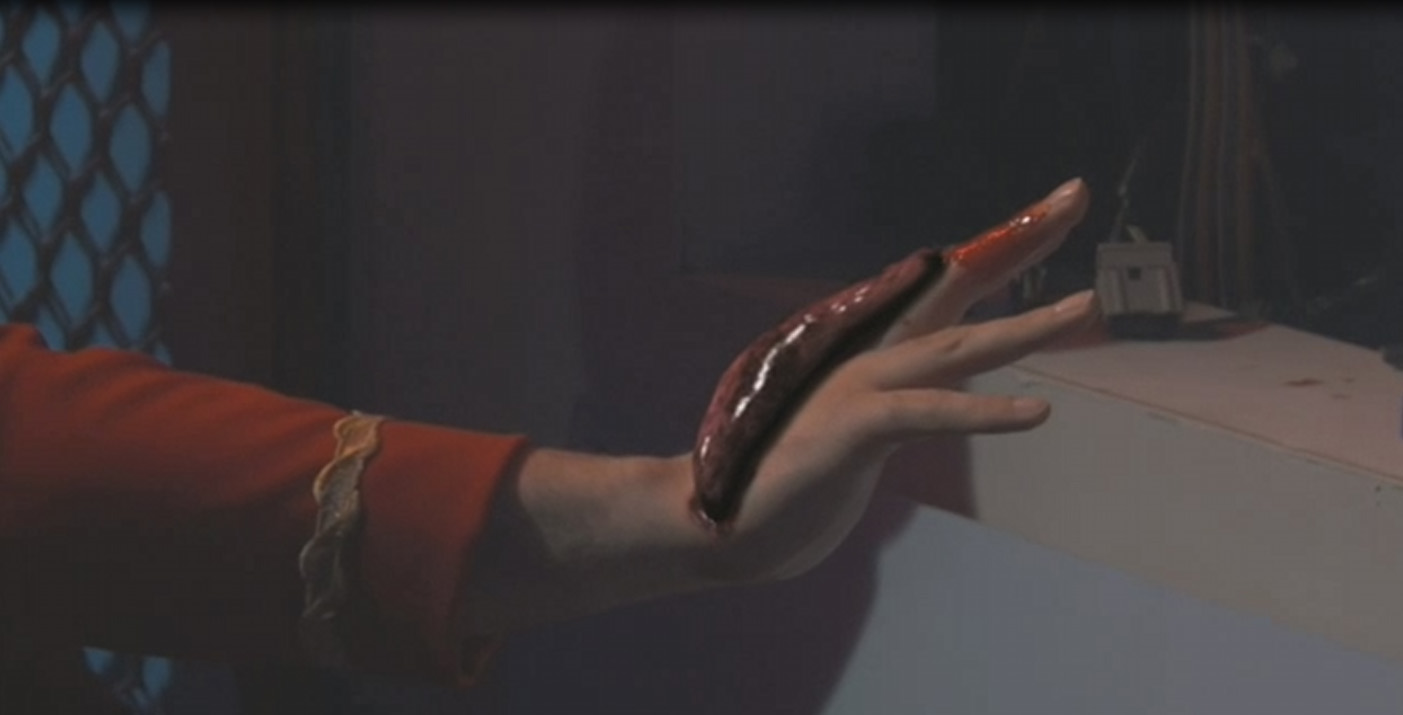
The creature commonly known as bloodworm or plasmacyte is the result of a deliberate mutation, presumably by the Regulans, a manipulation of creatures known as wavicle spores for waht is believed to be military purposes.
Wavicle spores were originally mostly harmless creatures, using oxygen only as a catalyst for tranformation in their next life cycle. After their mutation, when entering in contact with a redblooded creature, they turn to particles and, at certain level of concentration in an organism, transform into plasmacytes aka bloodworms, leech-looking creatures which feed aggressively on the blood of living organisms. In this state, the creature uses more energy eating than it gains by doing so and is therefore stuck in a loop in which what it eats only fuel its own appetite. They cannot really be killed, as destroying their form only shatteres them back into wavicles, ready to turn to particle when reexposed to blood. As such, the plasmacyte state could be considered a disease, one that can only be cured by reversing the mutation.
Without the mutation, wavicle spores would, when achieving a given level of concentration, turn into giant wavicle butterfly-like form refered to as Sparkle Dancers. It remains uncertain if in natural conditions, they would require an organic host to do so or just a sufficient amount of oxygen or other gas would suffice.
Source: Star Trek Universe. (Star Trek Phase 2: Blood and Fire) It remains uncertain that theinterpretation of the Regulan Bloodworm described aboce is canon to the official Star Trek universe. It nevertheless is now officially part of the pop culture related to that franchise thanks to the people at Star Trek New Voyages who made the creature pivotal to the Blood and Fire episode of their webseries. What is officially known about the bloodworm is that, under its plasmacyte state, it was native/discovered in the Regulan system. It has been described as soft and spineless. Medically, it has been known to be used medically under controlled conditions in the 22nd century for cleansing a being's lymphatic system. (ENT: "Doctor's Orders"). What the Blood and Fire episode (and the novel and TNG rejected episode it is based on) added to the lore was that the plasmacyte was developed by the Regulans as a biological weapon, that the leeches reproduced at an astronomical rate and wiped out the Regulans. Once left without nurrishment sources, they starved and shattered, reverting to their wavicle state until space explorer came to the Regulan system. As the wavicles appear to be able to survive in space, it remains unknown if, under their initial state, they were indigenous to the Regulan system or came to be there by other means.


Wavicle spores floating in the air. (Check small luminous specs).


Wavicle spores in their aberrant next life cycle, the plasmacyte aka Bloodworm.


The Wavicle spore's natural next life cycle state, the Wavicle Sparkle Dancer.


mardi 12 février 2013

VANDULL

Vandull are an aggressive sentient humanoid species which developed an interstellar civilisation.
Source: Star Citizen (upcoming Game) by Chris Roberts and Roberts Space Industries.
Note: This species has been announced as being part of the upcoming Star Citizen game universe. More informations will become available when the game comes out.

dimanche 10 février 2013

TELLARITES


Planet of Origin: Miracht AKA Tellar Prime, a planet of the star system 61 Cygni.
Tellarites are a stout omnicorous humanoid species with distinctive snouts who had developed a FTL space faring civilisation as of the 20th century. They wore beards and their hands were sometimes hoof-like in appearance, known to be passionnate, impatient, stubborn and proud people.
Tellarites were warp-capable and involved in inter-species communication by the 20th century and were in conflict with the Andorians at some point in the first half of the 22nd century, conflict whihc was ultimately sealed in November 2154 during the Babel peace conference during which was created a temporary alliance among the Andorians, Vulcans, Humans, and Tellarites, wh. The proceeding conference later helped bring peace to the strained Tellarite-Andorian relations. This coalition became permanent in 2156 with the start of the Earth-Romulan War and finally became the United Federation of Planets in 2161, after the war. 
Source: Star Trek Universe, TOS: "Journey to Babel", ENT: "Babel One", "United" ENT: "The Forge" ENT: "Carbon Creek"

jeudi 7 février 2013

BUU / GUNNIANS


Planet of origin: Gunn, a desertic planet saturated with sulfuric gases orbiting a red giant star in the Mikly Way galaxy.
Buu are a balloon-like floater species with three short pair of arms, each with two digits. They have one mouth and a pair of eyes on the front of their body. They are peaceful social creatures and live in pack but do not appear to have develop much technology.
They have been studied by the Kroons.
Source: Spirou Magazine issue 1973, 1975, pp91-92. in the short story "L'ancètre" (The Ancestor), by Michel Pierret and Francis Carin. Note: This story is based on the Smurfs character created by Peyo. Although it figures in the same media as the Smurfs, its canonicity in the official Smurf franchise remains debattable. Given the rarity of this story, which has to our knowledge, never been republished, it nevertheless remains, by the incredible amount of visual and text informations it delivers in the two pages it lasts, a very cool piece of pop culture. Thanks to the authors!

mercredi 6 février 2013

ZIKIMOUN / VIGALIANS


Planet of Origin: Vigal, in the Milky Way galaxy
Zikimoun are an aggressive warlike amphibian species living in the oceans of Vigal. They look remotely like feathreless and headless chicken with long spiked claws. They posssess two mouth, one at the top of their neck, barbed with spiked, which can extend a long prehensile tongue and a larger one on their chest, whihc sports sharp teeths and a pair of spiked like their arms and legs. Their chest is aslo where their eyes and nostrils are located.
They have been studied by the Kroons.
Source: Spirou Magazine issue 1973, 1975, pp91-92. in the short story "L'ancètre" (The Ancestor), by Michel Pierret and Francis Carin. Note: This story is based on the Smurfs character created by Peyo. Although it figures in the same media as the Smurfs, its canonicity in the official Smurf franchise remains debattable. Given the rarity of this story, which has to our knowledge, never been republished, it nevertheless remains, by the incredible amount of visual and text informations it delivers in the two pages it lasts, a very cool piece of pop culture. Thanks to the authors!

mardi 5 février 2013

GAAR / GARIANS


Planet of Origin: Gaar, a planet with four moons in the Milky Way galaxy.
Gaars move on 8 short legs. They possess one long headless neck containing their mouth and most possibly other sensory organs. Their back is covered with fur, as is the base of their neck. They appear to be surrounded by some sort of energy field.
They have been studied by the Kroons.
Source: Spirou Magazine issue 1973, 1975, pp91-92. in the short story "L'ancètre" (The Ancestor), by Michel Pierret and Francis Carin. Note: This story is based on the Smurfs character created by Peyo. Although it figures in the same media as the Smurfs, its canonicity in the official Smurf franchise remains debattable. Given the rarity of this story, which has to our knowledge, never been republished, it nevertheless remains, by the incredible amount of visual and text informations it delivers in the two pages it lasts, a very cool piece of pop culture. Thanks to the authors!

lundi 4 février 2013

ORULS / ZOOLIANS


Planet of Origin: Zool, a planet with a very large moon and surrounded by a lot of asteroids, situated in the Milky Way galaxy.
The Oruls are a sentient bipedal lifeform that has developed a preindustrial civilisation.Vaguely humanoid, they possess two opposable digits on their hands and feet. Their head sports two eyes, two nostrils and one mouth and they have turtle-like shells on their back and head. They were clothing and know how to work some metals.
They have been studied by the Kroons.
Source: Spirou Magazine issue 1973, 1975, pp91-92. in the short story "L'ancètre" (The Ancestor), by Michel Pierret and Francis Carin. Note: This story is based on the Smurfs character created by Peyo. Although it figures in the same media as the Smurfs, its canonicity in the official Smurf franchise remains debattable. Given the rarity of this story, which has to our knowledge, never been republished, it nevertheless remains, by the incredible amount of visual and text informations it delivers in the two pages it lasts, a very cool piece of pop culture. Thanks to the authors!

dimanche 3 février 2013

KROONS / KROONIANS / SMURFS / SCHTROUMPFS


Planet of Origin: (most presumably) Earth. Planet of residence (in the far future): Kroona, a planet orbiting Alpha Eridani (Achernar), some 139 light years from Earth.
The Kroon are a sentient blue skinned humanoid species that will live on Kroona at some point in the future and which has developed an peaceful  advanced space faring technological civilisation with limited space time technology. They are fascinated by galactic history and exobiology and have studied many alien species, among which:
  • The Oruls of Zool
  • The Gaar of Garia
  • The Zimimoum of Vigal
  • The Buu of Gunn
 Despite their science, they know nothing of their origins, although they seem conscient somehow not being originary of their present homeworld. To that end, they developed the Retror technology, able to scan time and space. Using it, they were able to track down their oldest ancestor, a Smurf (schtroumpf), a small blue skin creature that lived during the middle-ages in the remote areas of the Europe region of Earth, a planet orbiting the G3 star Sol. How they came to move to Achernar and evolve into Kroons remain unknown.
They are known to have kept throughout the ages some clothing trends, i.e. pants, shoes and hats of a white color for the majority and of a red color for the leaders.
Source: Spirou Magazine issue 1973, 1975, pp91-92. in the short story "L'ancètre" (The Ancestor), by Michel Pierret and Francis Carin. Note: This story is based on the Smurfs character created by Peyo. Although it figures in the same media as the Smurfs, its canonicity in the official Smurf franchise remains debattable. Given the rarity of this story, which has to our knowledge, never been republished, it nevertheless remains, by the incredible amount of visual and text informations it delivers in the two pages it lasts, a very cool piece of pop culture. Thanks to the authors!


dimanche 27 janvier 2013

VOGANS

Planet or Origin: Voga / Planet of Gold / Neo Phobos
Vogans  are grey skinned sentient humanoids with  deep-set eyes and protruding facial features on a large domed head with some scarce white hair on its backside and jaw. From observations, no sexually differenciation is apparent and reproduction methodes are unknown. Despite a surprisingly simple technology, such as motor-boats and projectile weapons, Vogans were in contact with offworlders - mainly for commercial and defensive reasons, as their planet contained unimaginable of gold, they were harassed during the war against the Cybermen in the 26th century. 
There planet's gold was used to create glitterguns which could kill Cybermen. In order to stop this, the Cybermen attempted to destroy Voga, they failed but the planet was nevertheless blasted into space. This forced the Vogans to move underground and set up a troglodyte isolationist regime. After floating in space for over 300 years, Voga was captured by Jupiter's pull. Shortly after this, the humans rediscovered Voga and put the Nerva Beacon in its orbit. 50 years later, the Cybermen learned of its whereabouts  and tried against to destroy it still to no avail. 
The Vogan are led by a High Council, which was in turn led by a President or Chief Counciller. The Council had their own militia, which defended the centre of the planet. The Vogan Guilds were represented by the Guardians, who protected the mining galleries and the surface of the planet. The High Council were in favour of the isolationist policy, while the Guardians believed that the Vogans should rejoin the rest of the galaxy. This schism caused a minor civil war, which happened to have occurred when the Cybermen tried to destroy it for the second time.
By the 40th century, Voga had been long since abandoned and was nothing more than a lifeless asteroid.
Source: Doctor Who Universe, (DWN: Revenge of the Cybermen, (EDA: Father Time),  (NSA: Night of the Humans) 
 

mardi 22 janvier 2013

MARTIAN BARBAPAPA / POUMPOUM


Planet of origin: it i never clearly stated if th Martian Barbapapa are originary from Mars as it is never clearly stated if the Barbapapa family found on Earth is originary from our planet. In both cases, it is indeed their home.
Martian Barbapapa look a lot like their earthly cousins, being sentient  highly malleable organic vaguely sluglike organism are to mimic on sight almost any shape they see even very complex mechanical contraptions such as ailsnes, submarines and such, or even to create original forms dedicated to specialised uses. They can live in almost any type of environments, demonstrate extraordinary learning capacities, being able to invent complex machinery, from sailboats to interplanetary spaceships, and possess uncanny empathy with all forms of life, being able to domesticate most animals upon contact.
Contrarily to their earthbound counterparts which come in all colors of the spectrum, martian barbapapas are black and white, either striped or dotted, and sport a pair o small antennas coming out of their forehead. Their social structure is based on a tightly knit familial structure. They live in deep martian canyons that they'veturned into gardens.
Source: Barbapspa on Mars, by Annette Tison and Talus Taylor.

dimanche 20 janvier 2013

SAN'SHYUUM / PROPHETS

Planet or Origin: Janjur Qom, a now destroyed planet with a gravity lower than Earth in the Milky Way galaxy.
The San 'Shyuum are a physically frail mammal-like species acting as leader caste in the interspecies interstellar community known as the  Covenant overwhich they exert complete religious and political control by enforcing a misguided theology based on the false belief that firing a interstellar-range weapon of mass destruction left by the now extinct species known as the Forerunners and known as the Halo Array will start what they call the Great Journey, transcending them into a god-like status. They are also responsible for studying all other Forerunner artifacts - considered holy - and with them to develop new technologies. Their position of power is based on the claim of having evolved on a former Foreunner colony.
Physically frail creatures, they prefer to move around using anti-gravity technology. A life of physical inactivity leaves most if not all Prophets withered and weak but they still remain a strenght greater than that of humans in their arms.  Each Prophet has distinct, often fur-covered lobes of skin hanging underneath their chin similar to a beard, known as "wattles". Prophets of greater age have skin lobes on either side of their heads reminiscent of ears; despite this resemblance, the San 'Shyuum actually receive sound at the back of the head. Older Prophets appear to lose the pigment in their skin as they age and turn a shade of grey, then white. Prophets have three digits on each hand. They have parts of their brain showing through absences of skin on their heads, while skin is still there, it may be possible that they evolved to allow their brain to grow to such a size that the skin is there simply to hold it in place. Anagatictechnologies gives them long lifespan but the fertility cycles of their females are short and few and far between, which would make it difficult for them to have children. 
With regards to naming practices, each San 'Shyuum has a given name and a family name. However, once they rise to a certain level in the bureaucracy, they prefer to be addressed by their title.
Sometime around 110,000 B.C. the San 'Shyuum were part of an alliance with the Humans' empire, forming a major power in the Orion Arm of the galaxy. During this period, they encountered the Flood for the first time, but the spread of the infection was successfully pushed back by the humans while it was still relatively minor. This alliance ended when the San 'Shyuum surrendered to the Forerunners during the following Human-Forerunner war. All San'Shyum on Janjur Qom were killed when the Halo Array was fired during the next Flood outbreak dubbed the Forerunner-Flood War. Their homeworld would eventually be reseeded with specimens that were preserved on the Forerunner Ark structure. Having lost nearly all memory of the Forerunners, the San'Shyum  discovered Forerunner technology on their homeworld and based their religion around the artifacts they found. The beliefs they developed led to bloody civil wars and part of the population leaving their planet, leaving it deeply scarred toward 2100 BCE.  
The war between the Sangheili and the San 'Shyuum began soon after their first encounter in 938 BCE. Sangheili believed that Forerunner technology should not be touched or used for personal gain while most of the San 'Shyuum believed otherwise, and disassembled Forerunner relics to produce their own versions. Their first meeting resulted in a bloody engagement. Physically the Sangheili were far superior. One Sangheili warrior was the equal to at least ten San 'Shyuum. However, technologically, the San 'Shyuum had the advantage and wiped out the Sangheili armada using hit-and-run tactics. 
Eventually in 852 B.C.E., in order to ensure the survival of both races, the Sangheili gave up their own conviction, and the two races merged to form the early Covenant with the San 'Shyuum as the head religious leaders and the Sangheili as the physical backbone and defenders of the Prophets. Soon after, their homeworld was destroyed approx. 648 BCE as the result of a natural stellar collapse and they moved to the mobile-planetoid High Charity which was in turn destroyed by the Sangheili when it was the scene  of a new Flood outbreak in the 2550ies. Their current total population is now estimated at less than one thousand.
Source: Halo Universe, Halo Wikia

dimanche 6 janvier 2013

JOTOKI


 Art by Souhjiro, copyright © 2009
(Note: no hyperlink was given to the author of this image on the site on which it was found. To anybody who has these informations, please froward them so that they may be added here. Thanks!)

Jotoki are non-humanoid sentient communal organisms that developed a space faring civilisation.
The Jotoki resemble large, spindly starfish. They are born as small aquatic swimmers, most of which are eaten by predators; in time, survivors will merge in groups of five to form one collective organism, which grows into an arboreal creature; its tails become arms, and its fins differentiate into fingers. When it grows large enough, the Jotok imprints itself on an adult and enters a stage of rapid learning and brain growth. A Jotok who desires a family can simply go into the wilderness and "harvest" an adolescent. Unimprinted adult Jotoki are considered feral, and regarded as little more than animals. Since the five subunits that make up one Jotok individual are not necessarily genetically related, reproduction does not require sex; a Jotok can simply find a pond and deposit its offspring to begin the cycle again.
The Jotoki were experts at trade. Their interstellar trade empire was quite developed for its time, but when the Jotoki attempted to use the Kzin as mercenaries, the Kzin revolted and conquered the Jotoki. Before their enslavement, Jotoki operated in groups called "clanpods", as part of their former planet-wide tradeweb. Details of this arrangement are not known. Jotok technological specialties included gravity polarizers, linguistics and biotechnology. They had the ability to force-grow clones to adulthood. The Kzinti believe that there is a free Jotoki fleet wandering amongst the stars, which would have provided their most strenuous opposition.
After the Man-Kzin Wars, humans recovered some Jotoki swimmers in an attempt to breed a free Jotok species.
Source: Larry Niven, Known Space Universe, (informations adapted from the Wikipedia entry), "The Asteroid Queen", by Jerry Pournelle and S.M. Stirling, "In The Hall of the Mountain King", by Jerry Pournelle and S.M. Stirling, "The Heroic Myth of Lieutenant Nora Argamentine", by Donald Kingsbury

dimanche 16 septembre 2012

COMPANION

Presumed planet of origin:  a planetoid in an asteroid belt located in the Gamma Canaris star system, less than 1000 ly from Earth, possibly a remnant of a planet breakup. It is one of 7000 bodies  in the asteroid belt, 34 % of which had some type of atmosphere. The composition of the planetoid is iron and nickel, and it had an atmosphere that consisted primarily of oxygen and nitrogen with traces of krypton, argon, and neon. The general surface temperature was 75 °F. Gravity was 1G.
Only one representative of this species is known. The Companion is a non humanoid lifeform  composed chiefly of ionized hydrogen and electricity. It appeared as a gaseous, vaguely sparkling cloud of yellow, orange, and red.It is able to communicate via telepathy with willing to do so. It has the ability to rejuvenate organic life, and inhibit the aging process, disperse or teleport itsel, produce material objects, including food and water and manipulate objects through telekynesis, produce electric discharges. It can also merge with a humanoid, creating a joined entity. In doing this, the creature sacrifices its immortality and most of its other powers. 
Source: Star Trek universe,  (TOS: "Metamorphosis")

UNNAMED ALIEN IN A FOREST


jeudi 13 septembre 2012

NIMONS / MINOTAURS


The Minotaurs are a minotaur-like humanoid species that developed a parasitic spacefaring civilisation on an interstellar scale. Parasitic by nature,  they fed on the faith of other life forms and survived by descending on primitive planets, setting themselves up as gods to feed on the worship of the natives. They could not feed on a person who held no strong beliefs. After a while when species became advanced, they usually managed to expell them upon realising their true nature.
A more dangerous offshoot of the species, called Nimon, could effectively drain not only faith but the very life force of their victim and could shoot blasts of energy from their horns. The Nimons were able to consume to extinction the population of an entire world within a few years. As their food source got scarce, they would look for another planet ripe for conquest and draining. A scout would descend on a planet, representing itself as a god with gifts of  advanced technology and start to construct a maze-like Power Complex  designed to generate a portal back to the Nimons' current planet. The Nimons would then migrate en masse to the new planet using capsules sent through the portal,  drain that world dry and look for the next, continuing the cycle they referred to as the Great Journey of Life.
They are said to have been one of many races that participated in the Millennial War some 150 million years ago against the Mad Mind of Bophemeral where they collaborated with the Osirians in dropping quantum collapsers on the insane computer intelligence. (PDA: The Quantum Archangel). At some point after the third millenium, after having drained the planet Crinoth, all traces of them was lost while they were travelling via their their portal toward their next prey, the planet Skonnos.
Source: Doctor Who universe,    (DW: The Horns of Nimon)  (DW: The God Complex)


YIRBEK


Planet of origin: Yirb, a planet in the Bek star system in the Andromeda galaxy.
They Yirbek are reptilian bipeds which developed an spacefaring civilisation and built a small interstellar empire before being conquered by the Skrulls some centuries before the third millenium. They have since then been used by their masters as mercenaries in minor galactic conflicts.
Source:  Marvel universe, Created by Stan Lee, Larry Lieber, Paul Laiken, Jack Kirby and Don Heck.  Avengers #14 ( march 1965)

HUSNOCK

The Husnock were an highly agressive species which developed and interstellar civilisation in the Milky Way galaxy with a population of over fifty billion before being eradicated in a split second by a Douwd after they had wiped out an Earth colony on which it was secretly living in 2366.
Source: Star Trek Universe (TNG: "The Survivors")

DOUWD

The Douwd are a peaceful immortal extragalactic uncorporeal species, self-described as "beings of disguises and false surroundings". Through their uncanny psychic powers, they have the ability to create and destroy on an interstellar scale and maybe more. Although they can't bring people back to life, they can make illusionary recreations of them. Although seamingly nearly omnipotent, they are not omniscient.
One Douwd has been known to travel the Milky Way,sometimes under the form of a human in the course of the 24th century. During that time, he destroyesd the Husnock civilisation after they had wiped out a human colony on which he was living.
Source: Star Trek universe, (TNG: "The Survivors")